
Lancaster Directory Holdings
For Lancaster research, the strongest documented directory shelf is regional. The Buffalo & Erie County Public Library's Grosvenor Room holds Buffalo City Directories from 1828 to the present and directories for other places. Its directory holdings can capture a Lancaster household in rural, suburban, business, route, or neighboring-town material, but a Buffalo volume is not proof that every town resident was included. Begin by checking the volume's title, territory, and date. Then keep the town, village, Depew, Bowmansville, and street variants together in the search notes.
| Collection | Years | Where Held | Access |
|---|---|---|---|
| Buffalo City Directories | 1828-present | B&ECPL Grosvenor Room | On-site shelf and research-service route |
| Digitized Buffalo directories | 1832-1913, 77 items | New York Heritage | Free online collection and image viewer |
| Buffalo and Erie directory databases | Buffalo 1861-1960; other runs vary | HeritageQuest and Ancestry Library Edition | Card or in-library access rules apply |
| Lancaster Public Library local history | Exact directory runs not listed | Lancaster branch | Non-circulating, in-person materials |
| Rural Directory of Erie County | Exact range not located | B&ECPL Digital Collections | Free digital browse |
No official holding list reviewed for this build identifies a complete printed Lancaster or Depew annual run, its publishers, or its first and last years. That is a real research gap, not a reason to assign a publisher or make a complete-run claim. Ask Grosvenor staff for the “City and Other Directory” guide and check each candidate volume before relying on a local listing.
Lancaster Grosvenor Directory Shelf
The Grosvenor Room genealogy collection is the deep regional stop for a Lancaster historical-directory search. Along with directories, it identifies newspapers, vital-index microfiche, yearbooks, maps, church and cemetery material, and family or local histories. The library advertises free obituary, directory, and article lookups through its research-services route. A focused request is more useful than a broad household request: provide a surname variant, likely year, locality, and street or business reference when known.
Its documented Buffalo shelf begins in 1828, a useful number because it shows the regional depth without pretending that the shelf is a Lancaster census. Later volumes may reflect growing suburban coverage, yet coverage depended on the publisher and circulation territory. When a name is missing, test a Buffalo, Depew, Bowmansville, or rural Erie County path before deciding the person was absent from the area.
Note: Record the volume title and its stated territory beside every result, since directory coverage and modern town boundaries are not the same thing.
Lancaster Digital Directory Scans
The New York Heritage Buffalo City Directories collection provides the documented free digital subset for this regional search. It contains 77 original-date items from 1832 through 1913 and offers a collection page and image viewer. The metadata for a 1872 item includes Lancaster, which demonstrates that Lancaster can appear in the searchable regional material. It does not establish that the scan holds every Lancaster household or that every regional volume uses the same arrangement.
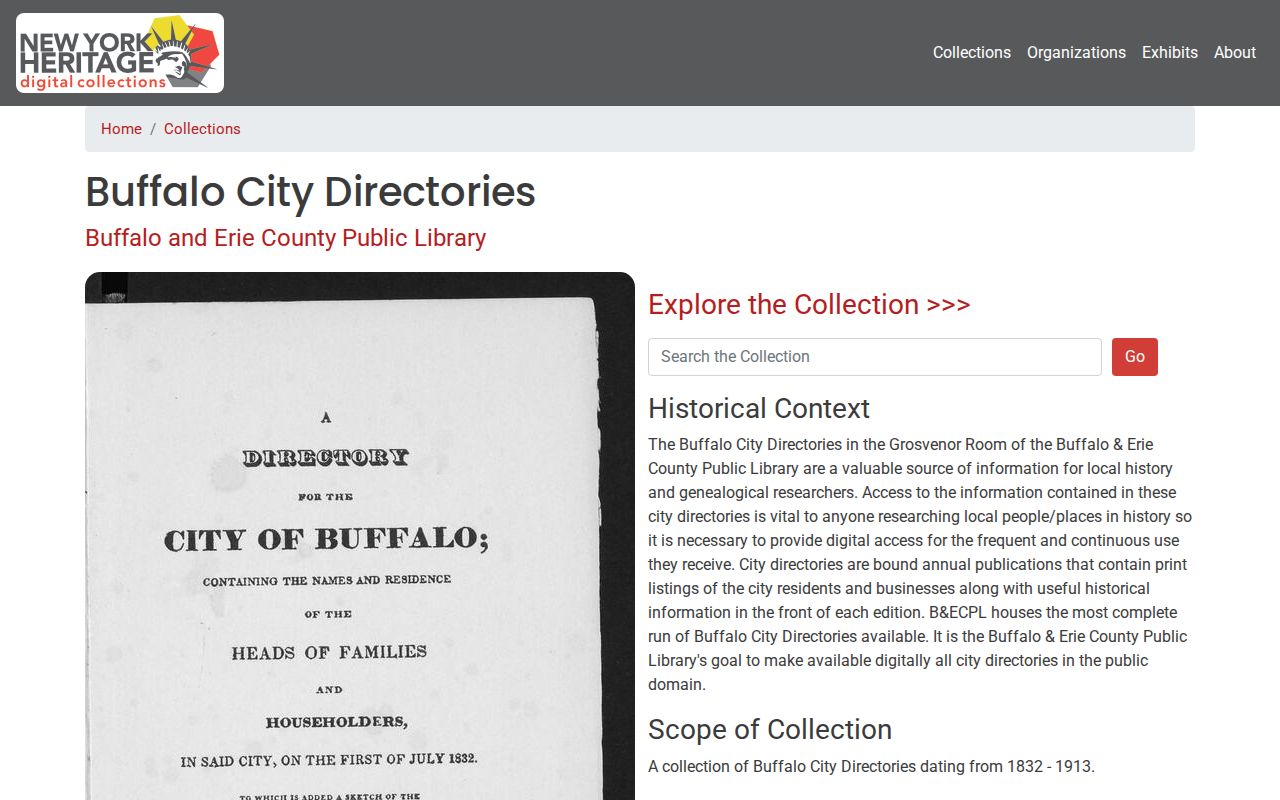
The digitized collection is best used as a volume-by-volume source. Search the surname, historical postal place, unshortened street name, and nearby locality, then inspect the page image and front matter rather than relying on OCR alone.
Lancaster Local-History Directories
Lancaster Public Library at 5466 Broadway holds non-circulating local-history material arranged around Lancaster and Depew, yearbooks, and Western New York, state, and national history. The branch also points researchers toward New York State Heritage material. Its local collection can supply the setting around a directory name, especially a yearbook, local-history file, or printed context that would not appear in a regional alphabetical listing.
The access path matters. Visit the branch for the non-circulating collection, use Grosvenor for the wider directory and newspaper shelf, and use the library's digital-collection links for material available online. Ask before a visit whether an item is on site, whether a staff lookup is required, whether photography is allowed, and whether a reproduction fee applies. Those details were not published as a universal rule for every item.
Lancaster Historical Society Files
The Lancaster NY Historical Society is a local contact lead for material that complements a historical directory. Its museum is at 40 Clark Street, and the organization describes preservation, education, landmarks, an 1868 Schoolhouse, and photo and book scanning stations. Online holdings are not itemized, so ask about family files, photographs, school records, ledgers, newspapers, and house material before assuming a particular directory or register exists.
The Society lists museum hours on the second and fourth Sunday from 2 to 4 p.m. and asks users to contact it to schedule scanning. The 1868 Schoolhouse at 3703 Bowen Road is listed for third Sundays from June through October. Confirm access before traveling because these are collection and museum channels, not a public name-search database.
Interpreting Lancaster Directory Entries
A directory entry is a compact historical snapshot, not a modern identity record. The library describes annual volumes as listing names, addresses, and occupations of city residents, with business and institution listings plus front matter. The inspection below is a field checklist drawn from that description. No actual Lancaster entry was selected in the available web research, so no local abbreviations, ownership marks, or publisher-specific conventions are asserted here. Photograph or note the key inside the exact volume before interpreting any shorthand.
| Name | Surname and given name or initial, with spelling checked against the page image. |
|---|---|
| Address | House number, street, and the locality or territory printed by that volume. |
| Occupation or business | A historical directory field that can distinguish same-name entries, when supplied. |
| Spouse or widow notation | A relationship notation, when printed, to test with other records. |
| Owner or renter mark | Only if the exact volume's key supplies one; no Lancaster-specific mark was verified. |
| Abbreviation key | Front-matter explanation that should be captured with the entry. |
- Criss-cross directory
- A directory arranged by street and address rather than primarily by surname. Use it only when the selected volume contains that section.
- Householder index
- An alphabetical index that points to the person or household named by the volume, not necessarily every person at the address.
- Abbreviation key
- The publisher's explanation of shortened labels and marks, usually found in introductory pages.
- OCR
- Text created from a scan that helps locate a page but can misread initials, names, and older type.
Lancaster Directory Companion Sources
A directory year becomes more useful when it is paired with a source that answers a different question. The B&ECPL genealogy databases include Ancestry Library Edition, available in the library, HeritageQuest for eligible cardholders, and Sanborn Maps of New York for 1867 through 1970, including more than 50 Erie County locations. The same library network points to newspapers, yearbooks, vital indexes, atlases, and the Rural Directory of Erie County.
Pair a directory near 1929 with the 1930 census, or one near 1939 with the 1940 census, while allowing for publication and enumeration dates. A census supplies household composition and enumerator geography; a directory supplies a named address or occupation snapshot. Neither proves current residence. Newspaper, obituary, cemetery, church, deed, and map evidence can test whether a disappearance reflects a move, a death, a territory change, or an unlisted household.
Note: Keep an unresolved spelling, locality, or date conflict in the research notes instead of merging two same-name people.
Lancaster Directory Records Timeline
Directory research in Lancaster sits inside a layered Erie County history. Erie County was officially recognized in 1821, and Lancaster became its own town in 1833. Town, village, county, and state sources therefore coexist. The regional directory shelf is an important bridge, but it must be read with the jurisdiction printed in the source, the street spelling, nearby cross street, and household names rather than mapped directly onto a current parcel boundary.
- 1821: Erie County was officially recognized by New York.
- 1828: Grosvenor's documented Buffalo directory shelf begins.
- 1832: The digitized Buffalo directory subset begins.
- 1833: Lancaster became its own town.
- 1913: The documented digital Buffalo subset ends, while the Grosvenor shelf continues.
This timeline does not identify a first or last Lancaster-specific directory year. The research found no verified local directory publisher list, no documented county courthouse-loss story, and no verified Lancaster street-renumbering year. Those omissions should remain visible whenever an old address fails to line up cleanly.
Trace Lancaster Directory Households
Use a historical-directory trail as a sequence of separate observations. Start with the latest available relevant volume, capture its page and the abbreviation key, then move backward one year at a time. Names may appear as initials, married names, widow references, businesses, or surname variants. A listing can also be absent because the territory changed or the volume did not cover the household. When a historical listing needs a current-record check, use the separate Lancaster resident lookup route rather than treating the old volume as current proof.
- Find the first likely appearance, preserving the volume title, date, locality, page, spelling, and every printed field.
- Move through nearby years and note each address, relationship notation, occupation or business reference, and apparent gap.
- Search the street, locality variants, and any criss-cross section that the volume actually includes.
- Pair the closest directory year with the nearest released federal census, then compare names and place wording.
- Test a departure with newspapers, obituaries, deeds, cemetery material, or a relevant local-history file before drawing a conclusion.
The useful result is a documented trail, not a guess. Mark first and last appearances, preserve the original spelling, and state when coverage cannot distinguish a move from an omission. That restraint is especially important in Lancaster, where town, village, and regional directory territories can overlap.