
Finding Lancaster Residents
No single public list names everyone in Lancaster. So start with whatever fact you already hold. An address points first to the Town of Lancaster Property Record Online System, known as PROS. A recorded owner name belongs in the Erie County Clerk index. An older household may surface instead in a regional directory, census record, obituary, or probate file. Ownership, mailing address, and occupancy differ. None substitutes for the others.
Boundaries overlap here. The Town of Lancaster, the Village of Lancaster, the Village of Depew, and postal zones all cross one another. Record the municipality and ZIP returned with each parcel before making a request, so a stray Depew or Cheektowaga result never drifts into a Lancaster search.
- Normalize the address, municipality, and postal ZIP.
- Search the parcel in PROS and save its owner style, situs, mailing address, and SBL or PIN.
- Use the owner, instrument, book/page, or parcel clue in the Erie Clerk index.
- For a known voter, use the state lookup with required personal fields.
- For a past household, compare directory, census, newspaper, and probate evidence by year.
Lancaster Resident Records Offices
Lancaster offices split the resident trail between them. The town assessor holds current parcel context. The County Clerk keeps land records and filing indexes. Election-law limits tightly control what the elections office may share about voter registration. For a case, an estate, or an older household, a court or library is often the better next stop.
Lancaster Assessor
21 Central Avenue
Lancaster, NY 14086
Mon-Fri, 8 a.m.-4 p.m.
Town of Lancaster PROS
Erie County Board of Elections
134 West Eagle Street
Buffalo, NY 14202
(716) 858-8891
NYS voter lookup
The County Clerk also takes requests by mail. A web request form works as well. When an index lacks the needed year or record class, the court clerk, municipal office, library, archives, and historical society are practical fallbacks.
Lancaster Parcel Records First
PROS covers assessment data, property inventory, and comparable sales for Town of Lancaster parcels. Its live controls are fully interactive, so do not assume an unlisted filter exists. Search by owner, property, or address. Then preserve the returned SBL or PIN. The card distinguishes situs, the physical parcel location, from the mailing address used for tax notices. That difference matters for estates, trusts, corporations, and owners who receive mail elsewhere.
The PROS property portal is a current property source. It is not a complete household roll.
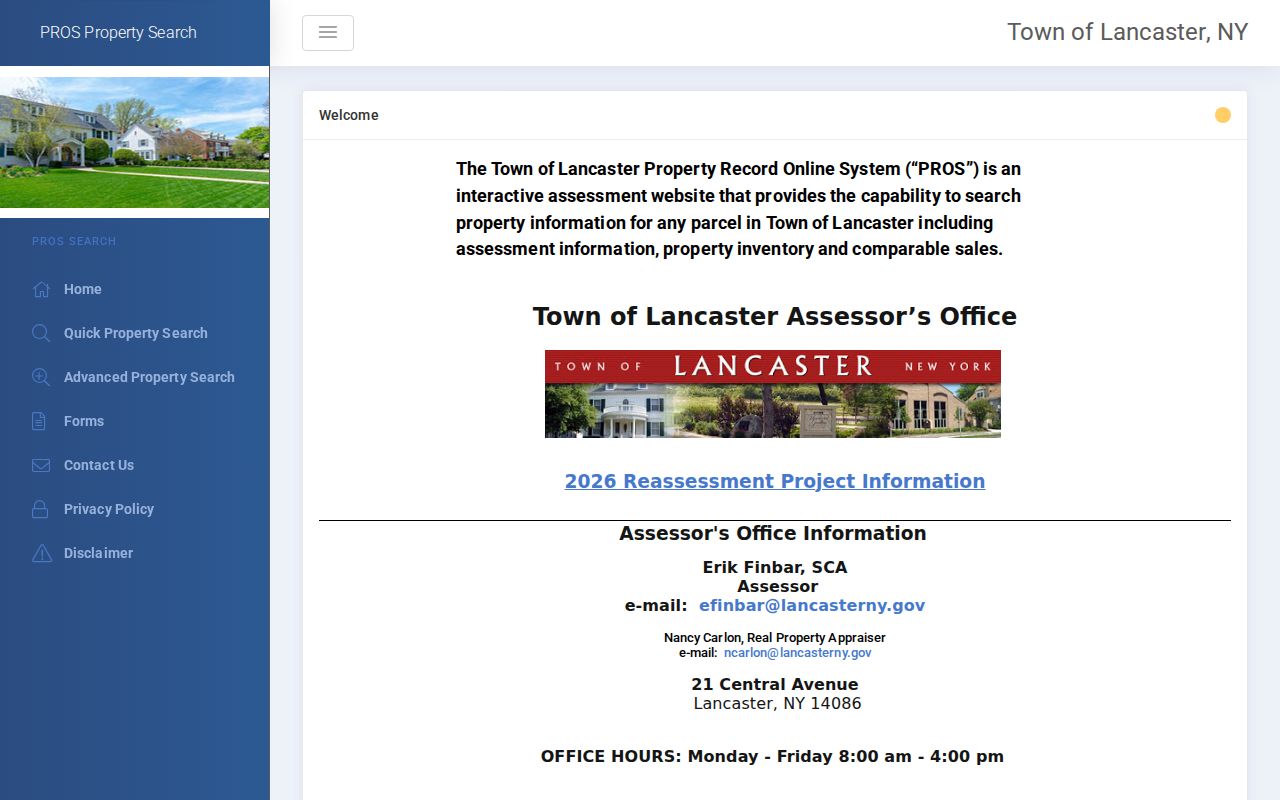
Parcel details then bridge into recorded land information. Confirm any surprising result with the assessor's office.
| Parcel clue | Use | Limit |
|---|---|---|
| Situs address | Locates the physical parcel | Does not identify all occupants |
| Mailing address | Shows where notices are directed | May not be the owner’s residence |
| SBL or PIN | Links parcel, map, and deed work | Format varies by system |
Lancaster Deed Search Bridge
The Erie County Clerk skips street-address deed searches entirely. The local sequence runs two steps by design. Find the parcel first. Then search the Clerk by party name, document type, instrument number, book/page, map number, or parcel ID. BrowserView takes a party as Last-Name First-Name without a comma, with optional town and document-type filters and MM/DD/YYYY date ranges. Its land index reaches 1986. Deed images begin in 1960, and the Erie Clerk BrowserView screen displays the party, document, parcel, map, and date routes.
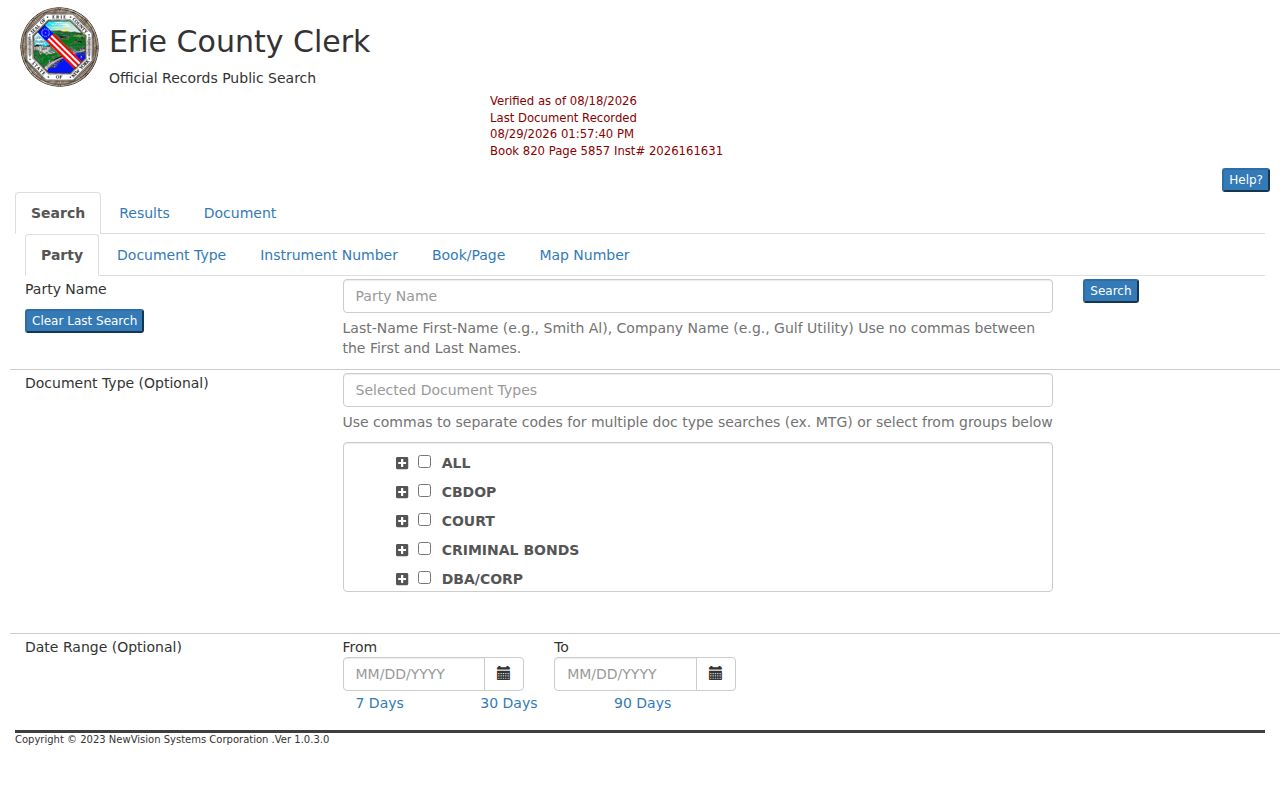
Deeds from 1960 to 1985 need older routes. Try the liber, or book-and-page, path. The Graves grantor/grantee index and, for earlier work, the Clerk's public terminal, books or microfilm, staff assistance, or a precise written request round out the options.
Current Lancaster Resident Sources
Current directory-like sources answer different questions, so label what each result actually establishes. A property record identifies a listed owner or mailing address. A voter inquiry checks submitted registration details. A recorded deed names parties to that document. None of these automatically identifies every member of a household.
| Source | What it can establish | Access route |
|---|---|---|
| PROS property record | Current parcel owner, situs, mailing and assessment context | Town portal or assessor |
| Erie Clerk index | Parties to deeds, mortgages, liens, and filings | Free index; images need registered or terminal route |
| NYS voter lookup | Personal registration or poll-site confirmation | County, name, DOB, ZIP, address fields |
| eCourts and WebSurrogate | Public case or estate index context | Online search plus clerk fallback |
| State business or license search | Public affiliation or status | State portal, not residence proof |
One-person verification is not a street search. The Lancaster resident lookup page focuses on comparing identifiers across the relevant records.
Lancaster Voter Confirmation Limits
The state’s Poll Site Search, Voter Registration and Mail Ballot Tracker asks for county, last name, first name, date of birth, ZIP, and address information. It is a personal confirmation form, not a browseable directory of a block or street. Voter-file access is controlled by Election Law §§5-500 and 5-508, and use of derived information is limited by Election Law §3-103(5).
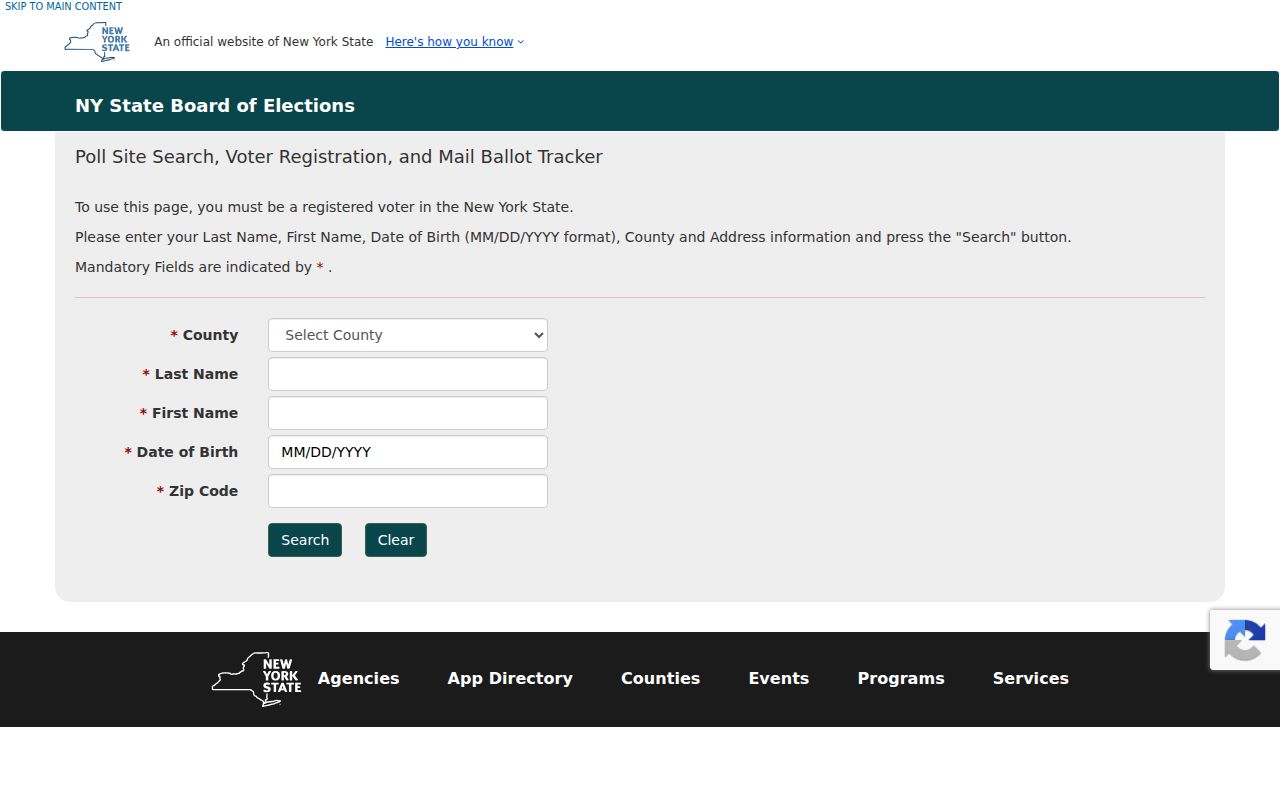
Confidential voter registration keeps qualifying records separate for four years. An Address Confidentiality Program participant may use a substitute address. A non-match proves nothing about residence.
Lancaster Court and Estate Names
Court results only make sense with case context. NYS eCourts splits its lookups across WebCivil Local, WebCivil Supreme, WebCriminal, WebFamily, and eTrack. Each screen asks for different search fields. A match can surface a case or index number, the caption, the court, a date, the judge or part, the status, and calendar details. Some matters stay hidden. Sealed cases, youth matters, adoptions, Article 81 proceedings, and other protected records do not appear. These are protected records kept out of public results. The NYS eCourts entry is an index route, not an identity conclusion.
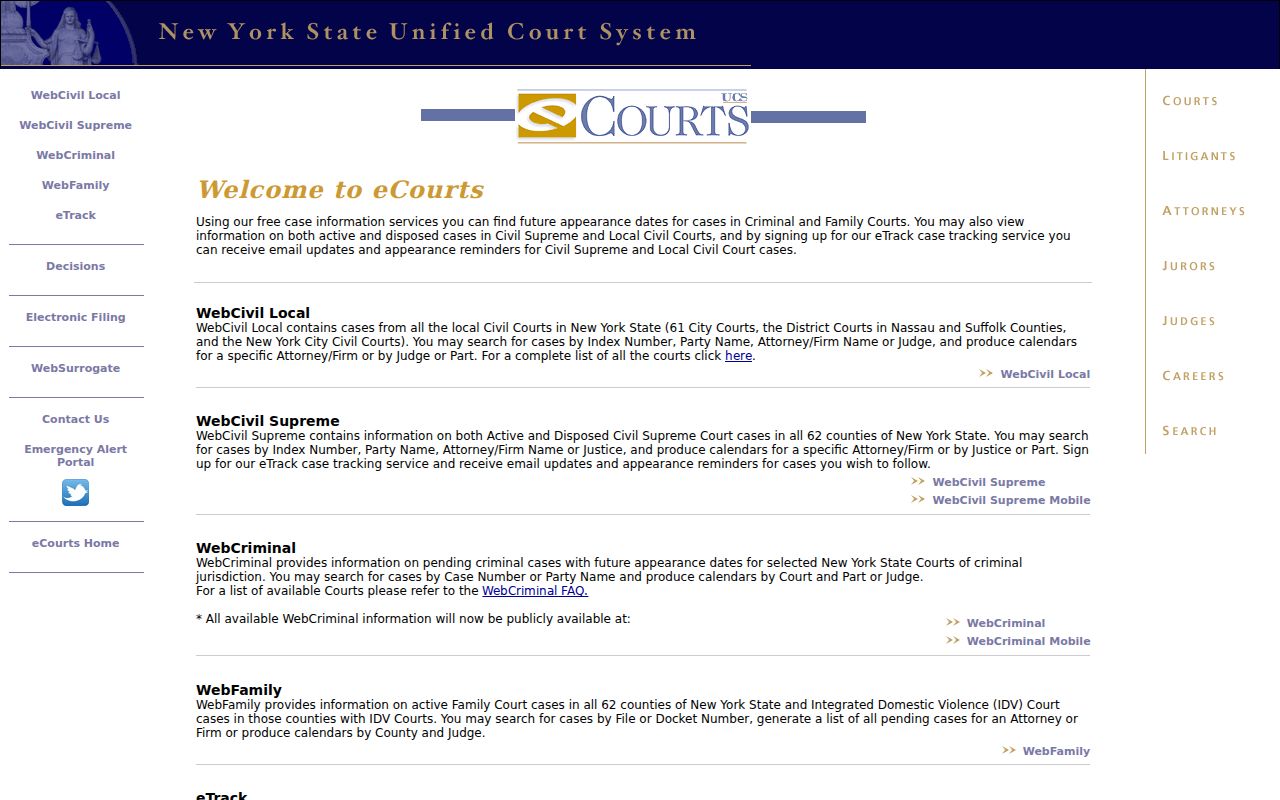
Estate research runs through Erie Surrogate's WebSurrogate. It offers name, file, old-index, index-book-page, and will search modes. Unrestricted document links generally start with February 19, 2014, while older unrestricted files can be viewed on courthouse public computers.
Lancaster Historical Directory Sources
Directory research for Lancaster households is a regional affair. Buffalo published the books, and the town rode along inside them. The Grosvenor Room at the Buffalo & Erie County Public Library keeps Buffalo city directories. Its run stretches from 1828 to the present. Digitally, the free New York Heritage collection covers scanned volumes from 1832 through 1913. No complete Lancaster-only annual run exists, so plan around that gap. Search under Buffalo, rural Erie County, Lancaster, Depew, Bowmansville, plus street and surname variants. One book will never cover the whole town.
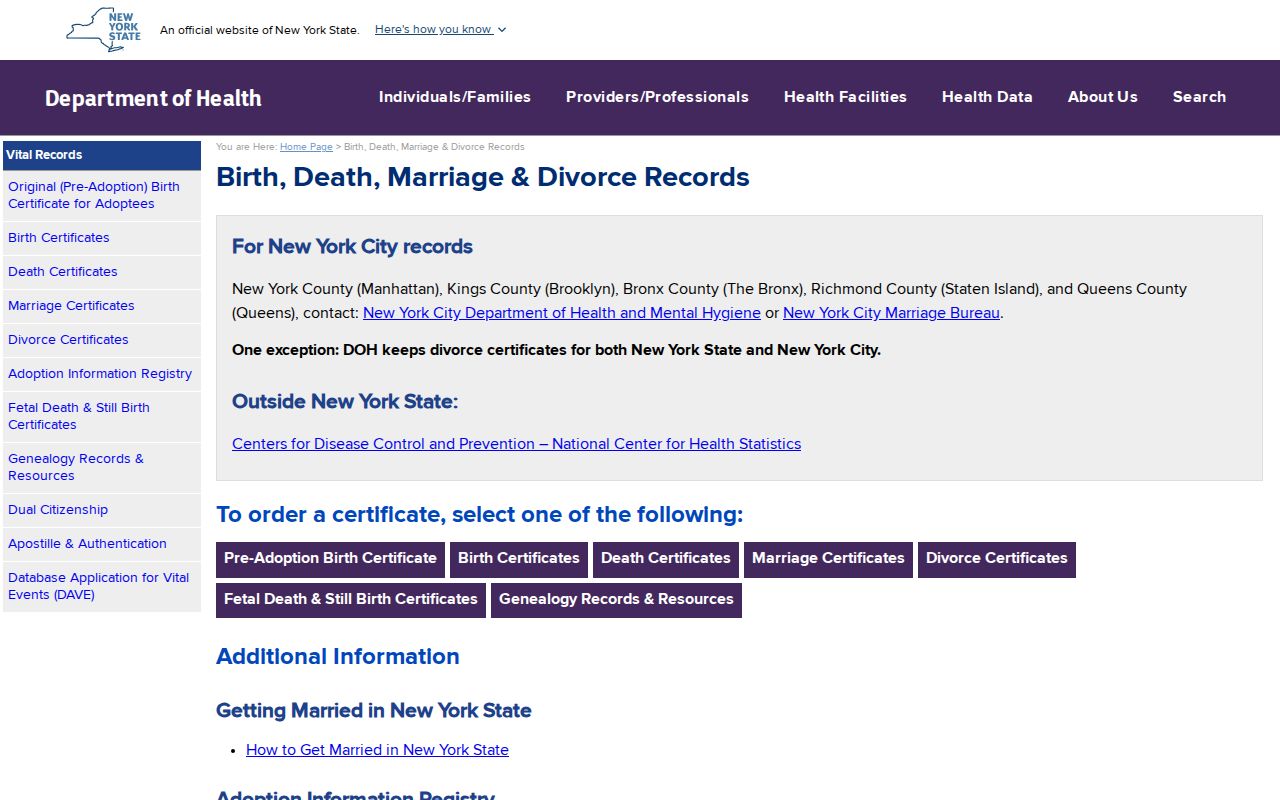
Start with the scanned volumes when you want to see the directories themselves. For dated births, deaths, and marriages, the state vital-record gateway shown above is the official entry point.
Lancaster Vital Record Windows
A Lancaster street address alone tells you nothing about where an event was filed. Start with the local registrar for the place the event occurred. Then turn to the New York State Department of Health. It holds statewide records outside New York City. Genealogy copies have waiting periods. Births must be at least 75 years old, with the person known deceased. Deaths open at 50 years; marriages at 50 once both spouses are deceased. Direct-line descendants can request an exception by proving descent and death. The DOH's Vital Records hub keeps historical index work apart from restricted certified copies. The genealogy route uses a mailed DOH-4384 form. It starts at $22 for a one-to-three-year search. It can run eight months or longer.
- Record index
- A finding aid that can identify an event and certificate number; it is not the certificate itself.
- Certified copy
- An official copy whose release depends on the record type and applicant eligibility.
- Criss-cross directory
- A directory section arranged by address rather than alphabetically by name.
- Parcel
- A mapped unit of land tied to an SBL or PIN for tax and deed work.
Lancaster Requests Beyond Portals
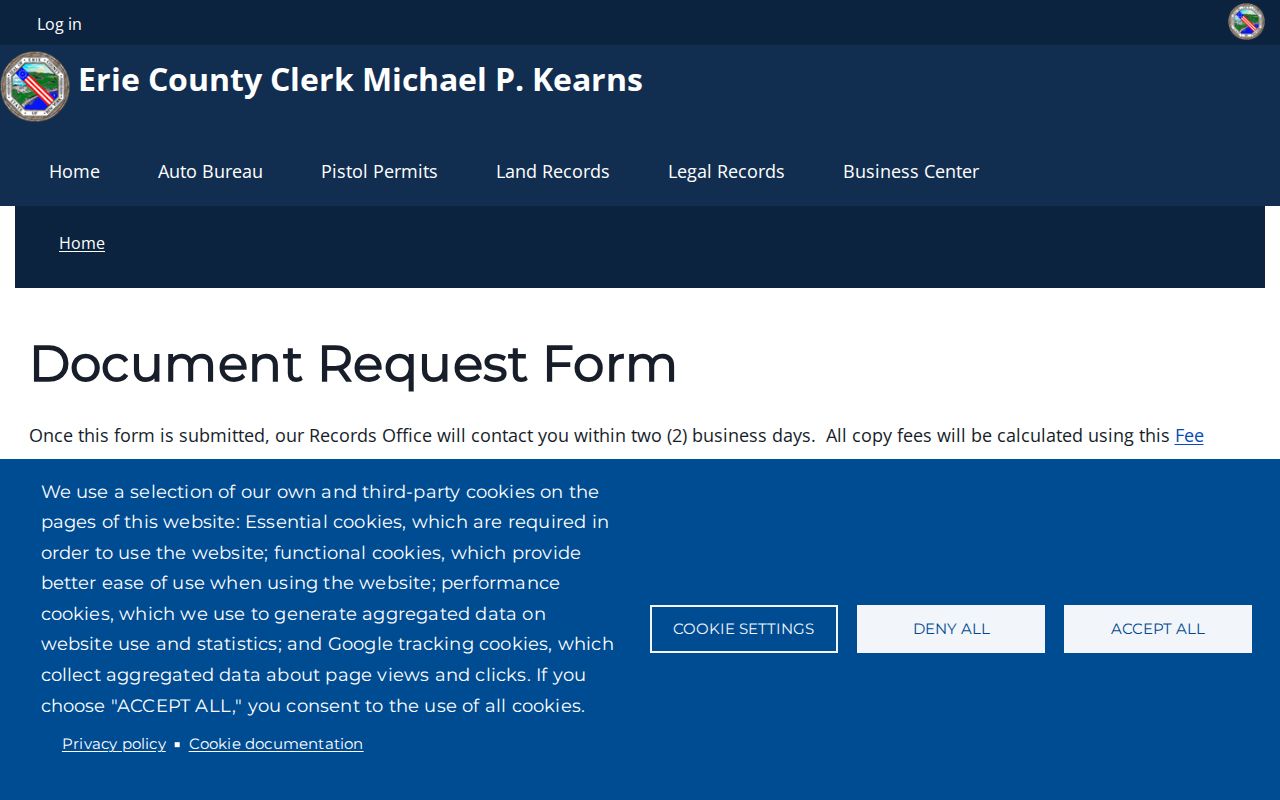
Once an online index runs dry, go to the channel that actually holds the record. The Erie County Clerk's document request form asks for your contact details plus clues: document type, approximate filing date, name, address, town, book, page, or index number. The office responds within two business days. Certified copies go out by mail, never email, and postage or similar charges can apply. An index search at the Clerk's public workstation opens an image-viewing route. The Erie County Clerk request form shows exactly which fields narrow a records request.
New York's freedom-of-information law, Public Officers Law Article 6, §§84-90, covers existing non-exempt agency records. Section 89(3)(a) generally requires an acknowledgment, grant, denial, or approximate response date. That response is due within five business days. Frame the request around a record that exists. An office is not obliged to build a new list for you.
Lancaster Property Alert Checks
Erie County's free Property Alert service watches recorded documents for exact S-B-L or party-name matches. It works best for a known parcel or a specific name spelling. John Doe, John Doe Jr., and John Doe II each count as separate exact matches. Register every relevant style to be safe. The service is not a title guarantee. It also does not stop fraud. If an alert surprises you, order a certified Clerk copy and contact the appropriate authorities. The Erie County Property Alert registration lays out the exact-match monitoring route.
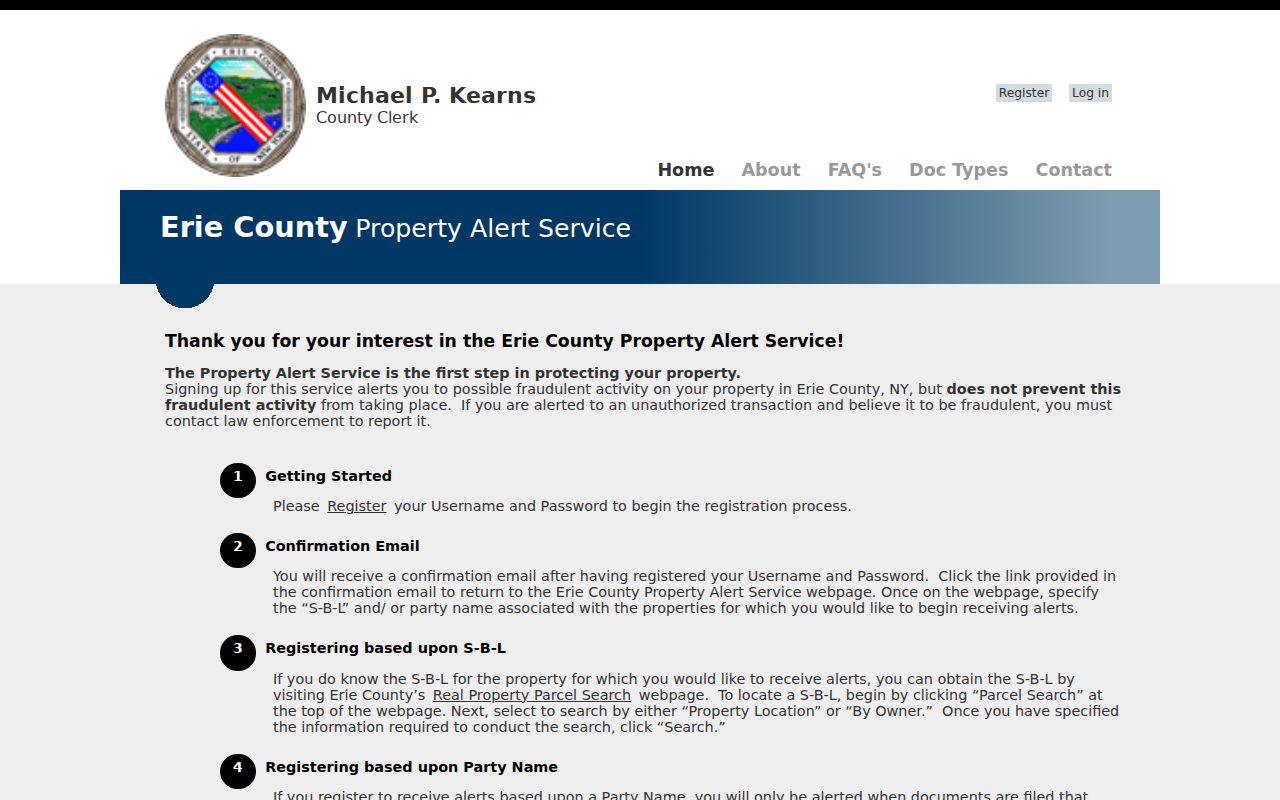
Register the S-B-L and every name style that applies. Then keep the alert email with its instrument information for later verification.
Lancaster ZIP and Parcel Lines
ZIP 14086 is the principal Lancaster postal ZIP. A postal label, though, is not a municipal boundary. Neighboring codes 14043, 14004, 14227, and 14221 show up in wider regional context and need address-level USPS confirmation before anyone ties them to a town parcel. Erie On-Map layers ZIP codes beside parcels, roads, school districts, and other map context. Parcels run current to 2025. The map itself is not a legal survey, the county cautions. The Erie County On-Map viewer carries the parcel and ZIP layers that let you compare postal and municipal context side by side.
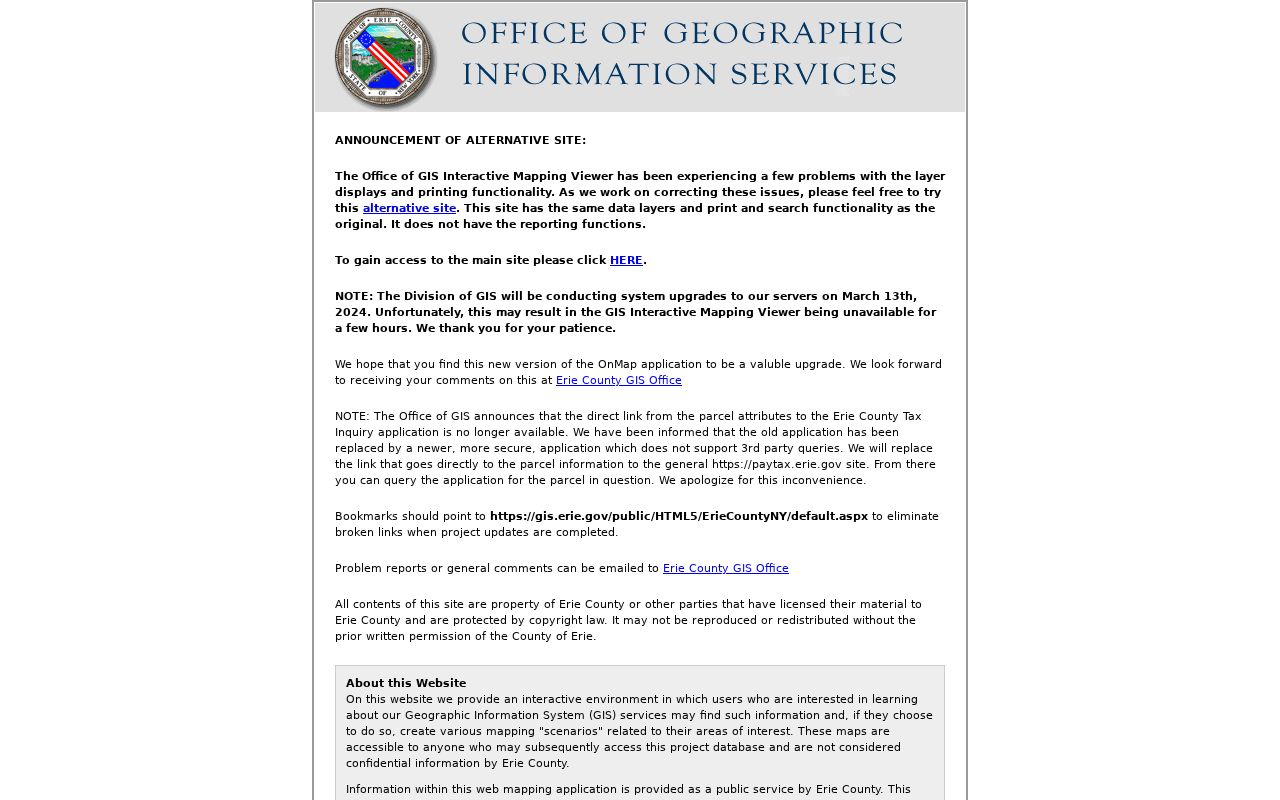
Walden Avenue and Transit Road make the split among town, village, and neighboring municipalities matter here. Keep the GIS town or village field beside the USPS result.
Lancaster Library Research Doors
The Lancaster Public Library at 5466 Broadway keeps a non-circulating local-history collection. Its shelves lean toward Lancaster and Depew materials, yearbooks, Western New York, New York State, and United States history. It also offers pointers to New York State Heritage material. As a first in-person stop for local context it earns its keep. The library makes no claim to a complete annual town-directory run, so adjust expectations. Come with a narrow surname, street, or date range. Ask whether the item is on site. Ask whether staff can help. Ask whether photographs or copies are allowed.
Deeper regional work belongs to the B&ECPL Grosvenor Room. It holds city directories, newspapers, vital-index microfiche, yearbooks, church and cemetery material, maps, and family histories. It also offers free obituary, city-directory, and article lookup services. The Lancaster NY Historical Society at 40 Clark Street is a third door. Its museum, 1868 schoolhouse, and three photo and book scanning stations complement the library. They do not replace it. Ask the Society directly about photographs, family files, school records, newspapers, and house material. Its online holdings are not itemized.
Note: A regional directory or newspaper can offer a strong lead. Weigh it against a parcel, census, vital index, or other independent record.
Lancaster Records Through Time
Lancaster grew into a separate town in 1833, twelve years after Erie County formed in 1821. That split history matters. A single household's paper trail can rest with a town, village, county, or state custodian. The depth of Erie's holdings is striking. Deeds run from 1808, mortgages from 1840, and lis pendens from 1829. Naturalizations span 1827 through 1929. Only the online coverage arrived late. When a Lancaster residents directory query comes up empty online, the wall is usually access, not absence.
The county's 2025 budget kept funding deed-liber scanning plus the free Property Alert service. That is preservation work. It does not put every old book online. If a household drops out of a modern index, try the Clerk's terminal or a records request, then lean on library street directory volumes, census releases through 1950, obituary notices, and Surrogate files, keeping the original jurisdiction and street spelling, especially near Depew and the town-village line.
Lancaster Search Detail Checks
Keep a small log as your Lancaster residents directory work jumps between systems. The habit pays off fast. For parcels, note the retrieval date, exact situs address, town or village, postal ZIP, SBL or PIN, owner style, and any book/page or instrument number. Clerk searches need their own notes. Record the party spelling, document type, town filter, date range, verified status, and the book, page, or instrument hit. Those details let you repeat a search later. They also keep a common surname from bleeding into someone else's file.
Compare results across record classes. Never merge them by reflex. A deed names a grantor and a grantee. A permit can point to an applicant, a holder, or a project, while a voter form reflects the details entered for an eligible lookup. A street directory entry places a head of household at a printed address in a given year. Every clue carries its own date and access rule. Names get messy. When a record shows a middle initial, suffix, spouse, trust, estate, or business form, keep it exactly as printed and weigh it against the property description, address, or date.
A missing result is a prompt, not a verdict. Go to the custodian's fallback before widening the claim. Erie Clerk material may need a public terminal, the Graves index, a book search, or a narrow document request. Lancaster town records may sit behind a counter or a FOIL request. Library and Historical Society holdings can call for an in-person visit, a staff lookup, or a scheduled scan. That path leaves a trail you can reproduce. It also keeps an incomplete online index from being mistaken for proof that no record exists.
Lancaster Record Privacy Limits
Public records do not add up to a license for assembling a private profile of someone's household. Federal DPPA rules shield DMV personal data. Utility and delivery customer lists are not resident indexes. Court, voter, vital, and Surrogate records each carry their own confidentiality rules. Commercial compilers merge same-name files and keep stale addresses. Treat them only as leads, never as substitutes for a custodian's own record.
Use records lawfully. Lancaster property, court, and directory sources are for personal research, family history, civic context, and fraud verification. Do not use a result to stalk, harass, intimidate, or harm anyone.
Corrections start with the office that created the record. Send the exact document or field with proof. The Address Confidentiality Program and the confidential-voter process provide safety protections that no ordinary resident lookup can override.